
Primary Keyword: Helonium
Long-Tail Keywords: Helonium
Introduction
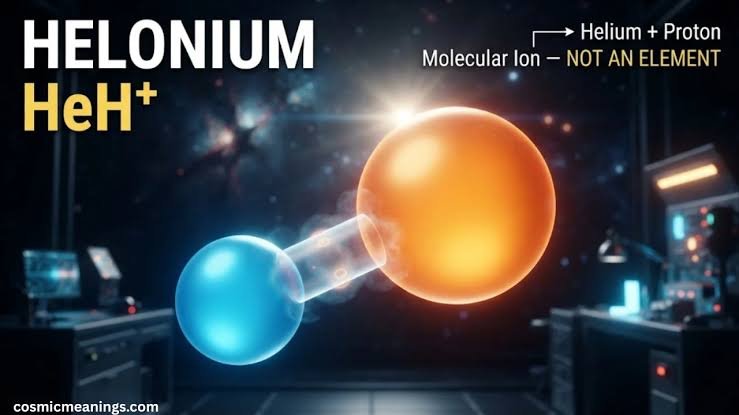
Helonium is an interesting scientific term connected with one of the simplest and most unusual molecular ions known in chemistry. The name can sound like that of a chemical element, but Helonium is not an element on the periodic table. Instead, it is another name for the helium hydride ion, written as HeH⁺. This positively charged molecular ion contains helium and hydrogen and has attracted attention from chemists, physicists, and astronomers because of its unusual properties and connection with the chemistry of the early universe.
What Is Helonium?
Helonium refers to the helium hydride ion, HeH⁺. The chemical formula provides a simple way to understand its composition. “He” represents helium, while “H” represents hydrogen, and the plus sign indicates that the overall species has a positive electrical charge.
Unlike helium, which is a neutral chemical element, Helonium is a molecular ion. It is therefore better understood as a chemical species rather than as a separate element.
The term is especially interesting because helium is known for being chemically unreactive under ordinary conditions. Its electron configuration makes it difficult for helium to form conventional chemical bonds. HeH⁺ demonstrates that under suitable conditions, helium can nevertheless participate in an unusual molecular ion.
Is Helonium a Chemical Element?
No, Helonium is not a chemical element.
The periodic table contains helium, which has the symbol He and atomic number 2. There is no element officially called Helonium. Instead, Helonium describes a molecular ion made from helium and hydrogen.
This distinction is important because the ending of the word can make it sound similar to element names. Chemical terminology, however, does not always mean that a substance is an element simply because its name sounds scientific.
A useful comparison is:
- Helium (He): A chemical element.
- Hydrogen (H): A chemical element.
- Helonium (HeH⁺): A positively charged molecular ion.
- Helium hydride ion: Another name for HeH⁺.
The Chemical Formula of Helonium
The chemical formula for Helonium is HeH⁺.
This formula contains two different elements. One is helium and the other is hydrogen. The positive charge tells us that the molecular ion has an overall charge of +1.
Because it contains two different atomic species, HeH⁺ is described as a heteronuclear diatomic molecular ion. Its simple structure makes it particularly useful for scientific research because researchers can study its behavior without the additional complexity found in larger molecules.
Why Is Helonium Interesting?
One major reason Helonium is scientifically interesting is the unusual chemistry of helium.
Helium is a noble gas and is famous for its low chemical reactivity. Its electrons occupy a stable configuration, which makes ordinary chemical bonding difficult. Yet helium hydride ion can exist under appropriate conditions.
This unusual behavior gives scientists an opportunity to study how atoms and ions interact under energetic or specialized environments.
The study of HeH⁺ also connects chemistry with astronomy. Molecules and ions found in space can provide information about the physical conditions of stars, nebulae, and other astronomical environments.
Helonium and the Early Universe
Helonium has an important place in discussions about early cosmic chemistry. After the universe became cool enough for atoms and simple chemical species to form, helium and hydrogen were among the important ingredients available for early molecular chemistry.
Because HeH⁺ is such a simple molecular ion, scientists have studied its possible role in the chemical development of the early universe.
This does not mean that Helonium was the only molecule involved in early cosmic chemistry. Instead, it is one of several simple species that can help researchers understand how increasingly complex chemistry developed after the earliest stages of the universe.
Helonium in Laboratory Research
The helium hydride ion has been studied experimentally for many years. Laboratory research has allowed scientists to investigate its molecular structure, reactions, energy levels, and spectroscopy.
Research involving HeH⁺ is useful because theoretical calculations can be compared with experimental observations. Since the molecule is so simple, it provides an excellent system for testing scientific models.
This is an important part of modern chemistry and physics: researchers often use simple systems to understand fundamental principles before applying those principles to more complicated molecules.
Helonium and Astronomy
Another fascinating part of the Helonium story is its connection to astronomy.
Scientists have searched for the spectral signature of HeH⁺ in space because molecules and ions can produce distinctive patterns of electromagnetic radiation. Detecting these patterns can allow astronomers to identify chemical species in distant astronomical objects.
The astronomical detection of HeH⁺ was an important development because it provided observational evidence that this unusual ion exists in space. Researchers identified its presence in the planetary nebula NGC 7027, with the detection reported in 2019.
This discovery helped connect laboratory chemistry with real astronomical environments.
Helonium vs. Helium
Although the names sound similar, Helonium and helium are not the same thing.
Helium is an element that exists as individual atoms under ordinary conditions. It is a colorless, odorless noble gas and is widely known for applications such as balloons, cryogenic systems, and scientific research.
Helonium, on the other hand, refers to HeH⁺, a positively charged molecular ion containing helium and hydrogen.
The simplest way to remember the difference is:
Helium = He
Helonium = HeH⁺
Understanding this distinction prevents one of the most common misconceptions about the term.
Is Helonium Used in Everyday Life?
Helonium does not have the kind of everyday applications associated with common materials such as helium, oxygen, or water.
Its importance is primarily scientific. Researchers study it to better understand molecular physics, chemical bonding, spectroscopy, astrochemistry, and the chemistry of space.
Although most people will never encounter HeH⁺ in everyday life, studying unusual molecules like this can improve our understanding of fundamental chemical principles.
Why People Search for Helonium
People may encounter the term Helonium while reading about chemistry, astronomy, molecular physics, or the early universe. Because the word resembles the names of chemical elements, it is natural to wonder whether it represents a new element.
Searching for the term can therefore lead to questions such as:
- What does Helonium mean?
- Is Helonium an element?
- What is the formula for Helonium?
- Is Helonium the same as helium?
- Where is Helonium found?
- Why is HeH⁺ important in astronomy?
The answer to these questions becomes much clearer once the term is connected to the helium hydride ion.
Conclusion
Helonium is a fascinating scientific term for the helium hydride ion, HeH⁺. Although it may sound like the name of a chemical element, it is actually a positively charged molecular ion made from helium and hydrogen. Its unusual chemistry makes it valuable for research into molecular physics and chemical bonding.
Its importance extends beyond laboratory chemistry. HeH⁺ has also played a role in astronomical research and discussions about the early universe. The confirmed detection of this ion in space demonstrated how a molecule studied in laboratories can also exist in distant astronomical environments.
Overall, Helonium provides a simple but powerful example of how chemistry can connect the smallest molecular systems with some of the biggest questions about the universe.
You May Also Read

One Comment