Information Security Analyst: Role, Skills, Responsibilities, and Career Overview
Information Security Analyst

Introduction
As organizations increasingly depend on digital systems, protecting computers, networks, applications, and business data has become an important responsibility. An Information Security Analyst helps organizations identify security risks, monitor systems, respond to potential incidents, and improve overall cybersecurity practices.
Information security analysts work across many industries, including technology, finance, healthcare, government, education, retail, and manufacturing. Their work combines technical knowledge with problem-solving, monitoring, communication, and risk-management skills.
What Is an Information Security Analyst?
An Information Security Analyst is a cybersecurity professional who helps protect an organization’s information systems and digital resources. Their responsibilities can include monitoring networks, reviewing security alerts, identifying vulnerabilities, maintaining security controls, and assisting with incident response.
The exact duties vary depending on the organization. A small company may have one analyst handling several security functions, while a large organization may have specialized teams for monitoring, threat detection, compliance, and incident response.
The primary goal is to reduce security risks and help protect information from unauthorized access, disruption, alteration, or loss.
Main Responsibilities
An Information Security Analyst can have a wide range of responsibilities. One important task is monitoring systems for unusual activity. Analysts may review security alerts, logs, and other technical information to determine whether an event requires further investigation.
They may also conduct vulnerability assessments. These assessments help organizations identify weaknesses in systems, applications, networks, or configurations.
Another responsibility is supporting incident response. When a security incident occurs, analysts may help investigate what happened, determine the affected systems, document findings, and support steps designed to limit the impact.
Security analysts can also contribute to security policies and procedures. They may help organizations establish appropriate controls for passwords, access, devices, software, and data.
Security Monitoring
Security monitoring is an important part of the job. Organizations generate large amounts of technical activity every day, and security analysts help identify activity that may require attention.
Analysts may use security information and event management platforms, endpoint security tools, network monitoring systems, and other technologies to review activity.
The analyst’s role is not simply to react to every alert. Many alerts can be harmless or expected. Analysts must examine available evidence and determine which events require additional investigation.
Vulnerability Management
Organizations regularly discover vulnerabilities in software, systems, and network configurations. An Information Security Analyst may help identify, document, prioritize, and track these weaknesses.
Vulnerability management often involves working with technical teams to understand the potential impact of a weakness and determine appropriate remediation steps.
Not every vulnerability has the same level of risk. Analysts may consider factors such as the affected system, exposure, potential impact, and available security controls when helping prioritize remediation.
Incident Response
When a suspected security incident occurs, an analyst may participate in the response process. This can involve reviewing alerts, collecting relevant information, documenting events, and coordinating with other members of the security or IT team.
Incident response requires careful communication and organized processes. Organizations often establish response plans before incidents happen so that employees understand their responsibilities.
After an incident, security teams may also review what happened and identify opportunities to strengthen controls and procedures.
Important Skills
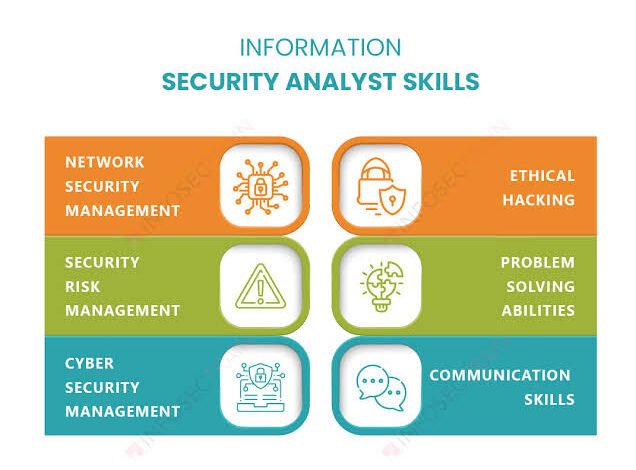
An Information Security Analyst benefits from a combination of technical and professional skills.
Technical skills can include networking fundamentals, operating systems, authentication concepts, security monitoring, vulnerability management, and basic scripting.
Analytical thinking is also important. Analysts often need to examine multiple pieces of information and determine whether they indicate a potential security problem.
Communication skills matter because analysts may need to explain technical issues to managers, IT professionals, employees, or other stakeholders.
Attention to detail is another valuable skill. Small configuration changes, unusual login activity, or unexpected system behavior can sometimes provide useful clues during an investigation.
Education and Training
There are several educational paths into information security. Some professionals study cybersecurity, information technology, computer science, or a related field.
Others develop their skills through practical experience, professional training, certifications, and self-directed learning.
A strong foundation in networking, operating systems, computing, and security principles can be particularly useful.
Because cybersecurity changes continuously, ongoing learning is an important part of the profession. Analysts need to stay familiar with new technologies, security practices, vulnerabilities, and defensive techniques.
Certifications
Professional certifications can provide structured learning and demonstrate knowledge in specific cybersecurity areas. The most appropriate certification depends on a person’s experience, career goals, and job requirements.
Some certifications focus on foundational security knowledge, while others cover areas such as security operations, risk management, cloud security, or incident response.
Certifications are not a substitute for practical skills, but they can complement education and professional experience.
Tools Used by Security Analysts
Security analysts may work with many different tools. Security information and event management systems can help collect and analyze security logs. Endpoint security platforms can provide information about activity on computers and other devices.
Vulnerability scanners can help identify potential weaknesses, while identity and access management systems help organizations control user access.
The specific tools used depend on the organization’s size, industry, infrastructure, security requirements, and technology environment.
Career Opportunities
Information security can provide opportunities across many industries. Analysts may work for technology companies, banks, hospitals, consulting organizations, government agencies, universities, and other businesses.
With experience, professionals may move into positions involving security engineering, incident response, threat analysis, security architecture, risk management, compliance, or security leadership.
Career development often depends on a combination of technical knowledge, practical experience, communication ability, and continued education.
Challenges of the Profession
Cybersecurity work can be challenging because technology and threats continue to change. Analysts may need to investigate large volumes of alerts while determining which events deserve immediate attention.
The role can also involve communication across different departments. Security recommendations may affect business processes, so analysts need to explain risks and proposed solutions clearly.
Another challenge is maintaining current knowledge. New software, cloud technologies, vulnerabilities, and security practices require professionals to continue learning throughout their careers.
Importance of Information Security Analysts
Organizations rely on digital information for daily operations, making security an essential part of modern business. An Information Security Analyst helps organizations identify risks and strengthen their defenses.
Their work can contribute to better security awareness, improved monitoring, faster incident response, and more consistent security practices.
While no organization can eliminate every security risk, skilled security professionals can help reduce exposure and improve an organization’s ability to respond when problems occur.
Conclusion
An Information Security Analyst plays an important role in protecting modern digital environments. From monitoring security events and identifying vulnerabilities to supporting incident response and improving security controls, analysts perform a variety of responsibilities.
The career requires technical understanding, analytical thinking, attention to detail, communication skills, and a willingness to keep learning. As organizations continue to depend on digital technology, information security remains an important professional field.
For people interested in cybersecurity, developing strong computing fundamentals, gaining practical experience, and learning continuously can provide a useful foundation for exploring this career path.
You May Also Read




One Comment