
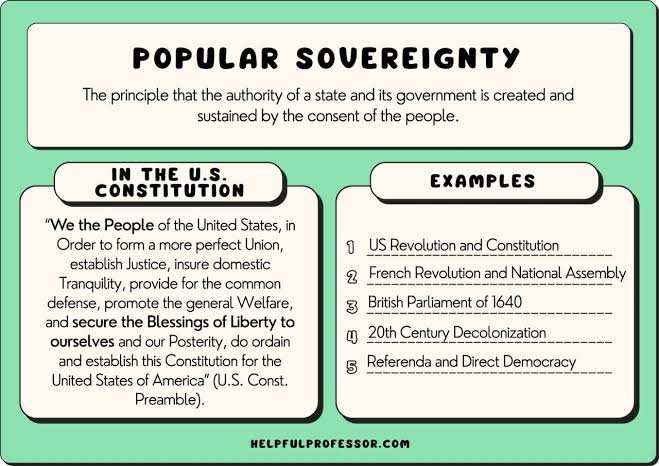
Popular sovereignty is an important principle of democratic government. It means that the authority of a government ultimately comes from the people. Instead of political power belonging permanently to a king, ruler, or small group, citizens are considered the main source of governmental authority.
The idea has played an important role in the development of modern democracy. It helps explain why citizens vote, participate in elections, express political opinions, and expect government officials to remain accountable to the public.
What Is Popular Sovereignty?
The basic meaning of popular sovereignty is that the people have the ultimate power to determine how they are governed. Citizens may exercise this power directly or through representatives they elect.
In a representative democracy, people normally do not make every government decision themselves. Instead, they choose officials who make laws and policies on their behalf. Elections therefore provide an important way for citizens to give or withdraw political support.
Popular sovereignty also suggests that government authority should reflect the will and consent of the population. Leaders are not supposed to possess unlimited power simply because they hold public office.
Origins of the Idea
The concept of popular sovereignty developed over a long period. Philosophers and political thinkers debated the relationship between government authority and the rights of ordinary people.
John Locke was particularly influential in developing ideas about government based on consent. He argued that legitimate political authority depends on the agreement of the governed. Later democratic movements expanded these ideas and connected them with representation, elections, and constitutional government.
The principle became especially influential during the political changes of the eighteenth and nineteenth centuries. As societies challenged traditional systems of hereditary rule, the idea that people should have a role in determining their government became increasingly important.
Popular Sovereignty and Democracy
Democracy and popular sovereignty are closely connected. A democratic system depends on the idea that citizens have a meaningful role in choosing their leaders and influencing public policy.
Elections are one of the clearest examples. When citizens vote, they participate in selecting representatives. If elected officials fail to satisfy voters, citizens can often support different candidates in future elections.
However, popular sovereignty involves more than voting. Citizens can participate through peaceful public discussion, civic organizations, petitions, community activities, and other lawful forms of political engagement.
A healthy democracy therefore requires opportunities for people to express their views and participate in public life.
Popular Sovereignty and the Constitution
In constitutional governments, popular sovereignty is often connected to the idea that government power is limited by law. The people may establish a constitution that defines governmental institutions and establishes rules for exercising political authority.
A constitution can divide power among different branches of government and establish protections for individual rights. These arrangements help prevent political authority from becoming concentrated in one person or institution.
Popular sovereignty does not mean that a temporary majority can necessarily do anything it wants. Democratic systems commonly include constitutional limits, legal procedures, and protections for fundamental rights.
Historical Importance in the United States
The principle of popular sovereignty became particularly important in American political history. The United States developed a political system based heavily on popular participation and representative government.
The Declaration of Independence expressed the idea that governments derive their legitimate powers from the consent of the governed. The Constitution also begins with the famous phrase “We the People,” emphasizing the connection between government and the people.
During the nineteenth century, the term popular sovereignty was also used in a more specific debate concerning slavery in U.S. territories. The idea proposed that residents of certain territories should decide through political processes whether slavery would be permitted there.
That historical use became controversial and contributed to intense political conflict before the American Civil War.
Why Popular Sovereignty Matters
The importance of popular sovereignty comes from its emphasis on political accountability. If government authority ultimately belongs to the people, leaders have a responsibility to serve the public rather than treat political office as personal property.
The principle can encourage citizens to become informed about public issues and participate in civic life. It also provides a foundation for peaceful changes in leadership.
Without meaningful public participation, government can become disconnected from the people it is supposed to represent.
Examples of Popular Sovereignty
There are many everyday examples of popular sovereignty in democratic societies.
Voting in elections is perhaps the most obvious example. Citizens select candidates and representatives who will make public decisions.
Referendums provide another example. In some political systems, citizens can vote directly on particular laws or policy questions.
Public participation is also important. Citizens may attend public meetings, contact elected representatives, sign petitions, participate in community organizations, or express opinions through peaceful civic activities.
These examples demonstrate that political authority is connected to citizen participation.
Popular Sovereignty and Government Accountability
Government accountability is an essential part of the principle. Elected officials receive authority from voters, but they are expected to exercise that authority according to established laws and constitutional rules.
Citizens can monitor government actions through public information, journalism, civic organizations, elections, and other lawful mechanisms. When officials lose public confidence, elections can provide an opportunity for political change.
Accountability helps ensure that popular sovereignty remains a practical principle rather than simply an abstract idea.
Limits and Challenges
Although popular sovereignty is a powerful democratic principle, applying it can be complicated. Citizens may disagree strongly about important political questions, and different groups may have competing interests.
Another challenge is ensuring that all eligible citizens have a meaningful opportunity to participate. Barriers to voting, political misinformation, unequal access to information, and political polarization can affect democratic participation.
For this reason, popular sovereignty works best when supported by strong institutions, reliable information, fair elections, rule of law, and respect for lawful political disagreement.
Popular Sovereignty Today
Today, the concept remains relevant in democracies around the world. Modern citizens have many ways to communicate with public officials and participate in political discussions.
Technology has created new opportunities for civic engagement, but it has also created challenges. Social media can help people organize and share information quickly, while misinformation can make it harder for citizens to distinguish reliable information from false claims.
Education and informed participation are therefore important parts of maintaining effective democratic government.
Conclusion
Popular sovereignty is the principle that the people are the ultimate source of governmental authority. It connects government legitimacy with the consent and participation of citizens.
From political philosophy to modern democratic institutions, the concept has influenced how societies understand representation, elections, constitutional government, and political accountability.
Popular sovereignty does not simply mean that citizens vote. It also involves informed participation, civic responsibility, lawful political expression, and the ability to hold leaders accountable.
When citizens have meaningful opportunities to participate and government institutions respect the rule of law, popular sovereignty can provide a strong foundation for representative democracy. It remains an important concept for understanding how political power is created, exercised, and held accountable in modern societies.
You May Also Read

One Comment