
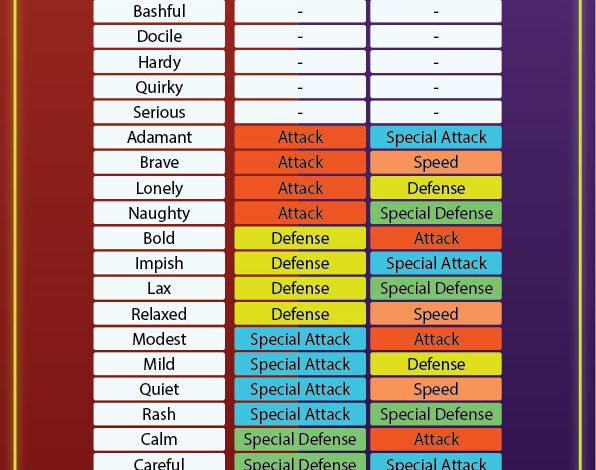
Pokémon natures are an important gameplay mechanic that can influence how a Pokémon performs in battle. Introduced in the third generation of Pokémon games, Natures add another layer of strategy by affecting certain stats. For players who enjoy competitive battles, training, breeding, or simply building a strong team, understanding Natures can make Pokémon preparation much easier.
A Nature does not completely change a Pokémon’s abilities, but it can influence the way its stats develop. This makes Natures particularly useful when players want to specialize a Pokémon for a particular role, such as physical attacking, special attacking, defense, or speed.
What Are Pokémon Natures?
A Pokémon’s Nature is a characteristic assigned to it. In the main Pokémon games, there are 25 different Natures. Most Natures increase one stat while decreasing another.
For example, a Nature can increase Attack while lowering Special Attack. Another may increase Speed while reducing Defense. Some Natures affect two stats in the opposite direction, while five Natures are neutral and do not create a stat increase or decrease.
Natures therefore allow players to fine-tune a Pokémon’s statistical strengths.
The Stats Affected by Natures
Natures can influence five major battle stats:
- Attack
- Defense
- Special Attack
- Special Defense
- Speed
HP is not directly affected by Nature.
The increased stat receives a bonus, while the decreased stat receives a corresponding reduction. This can be especially important when building Pokémon for specific battle strategies.
The 25 Pokémon Natures
There are 25 standard Natures in the main Pokémon games. They include:
- Hardy
- Lonely
- Brave
- Adamant
- Naughty
- Bold
- Docile
- Relaxed
- Impish
- Lax
- Timid
- Hasty
- Serious
- Jolly
- Naive
- Bashful
- Quirky
- Sassy
- Careful
- Gentle
- Modest
- Mild
- Quiet
- Rash
These Natures can be grouped according to the stats they influence.
Five of them—Hardy, Docile, Serious, Bashful, and Quirky—are neutral. They do not increase one stat while decreasing another.
Why Natures Matter
Natures are particularly important because even a relatively small statistical difference can matter in competitive battles.
Suppose a player wants a Pokémon to focus on physical attacks. A Nature that increases Attack while lowering a less useful stat may help support that strategy.
Similarly, a Pokémon designed to rely on special attacks may benefit from a Nature that increases Special Attack. A fast Pokémon may benefit from a Nature that increases Speed.
The best choice depends on the Pokémon’s role, moves, abilities, and overall team strategy.
Pokémon Natures and Physical Attackers
Physical attackers generally depend on the Attack stat. Players building these Pokémon may select a Nature that increases Attack.
Adamant is a well-known example because it increases Attack while decreasing Special Attack. This can work well for Pokémon that primarily use physical moves and do not rely heavily on Special Attack.
Other Nature choices may be appropriate when Speed or another stat is more important to the intended strategy.
Pokémon Natures and Special Attackers
Special attackers generally rely on Special Attack rather than Attack.
Modest is one commonly recognized Nature for this type of build because it increases Special Attack while reducing Attack. If a Pokémon primarily uses special moves, reducing its physical Attack may have little impact on its intended role.
However, some Pokémon use both physical and special moves, so a different Nature may be more suitable.
Speed-Focused Pokémon
Speed can be extremely important in Pokémon battles because it can determine which Pokémon acts first.
Timid and Jolly are commonly associated with Speed-focused builds. Timid increases Speed while lowering Attack, making it useful for Pokémon that primarily rely on special attacks.
Jolly increases Speed while lowering Special Attack, making it more suitable for Pokémon that primarily use physical attacks.
Choosing between these options depends on the Pokémon’s moveset and battle strategy.
Defensive Natures
Defensive Pokémon can also benefit from carefully selected Natures.
A Nature that increases Defense can support a Pokémon intended to withstand physical attacks. Likewise, increasing Special Defense can be useful for Pokémon expected to handle special attacks.
Bold and Calm are examples of Natures that can support defensive strategies, although the appropriate choice depends on the Pokémon and its role.
Neutral Natures
Not every Nature changes two stats. Five Natures are neutral.
Hardy, Docile, Serious, Bashful, and Quirky do not provide a statistical increase or decrease. These Natures can still be found naturally on Pokémon, but competitive players often prefer a Nature that supports a specific build.
For casual gameplay, however, a neutral Nature is not necessarily a problem.
How to Check a Pokémon’s Nature
Players can generally view a Pokémon’s Nature through its summary information. The exact presentation can vary between Pokémon games.
Checking the Nature is useful when deciding how to train a Pokémon. If its Nature supports its intended role, players may choose to invest further in that Pokémon.
Modern Pokémon games also provide additional tools that can make training and stat management more flexible.
Nature and Pokémon Personality
In addition to affecting stats, Natures have traditionally been associated with personality descriptions in Pokémon games.
These descriptions provide flavor and are separate from the main statistical effect of the Nature. This combination of gameplay mechanics and personality characteristics helped make Natures an interesting part of Pokémon’s design.
Can a Pokémon’s Nature Be Changed?
Some Pokémon games provide ways to alter the effective stat influence of a Pokémon’s Nature through special items or mechanics.
Mint items, for example, can change which Nature’s stat effects are applied without necessarily changing the Pokémon’s original Nature information.
This gives players more flexibility when developing Pokémon for particular roles.
Choosing the Right Nature
There is no single Nature that is best for every Pokémon. The right choice depends on several factors:
- The Pokémon’s base stats.
- Its available moves.
- Its ability.
- Its intended battle role.
- The player’s overall team strategy.
- Whether the Pokémon focuses on physical or special attacks.
- Whether Speed is an important part of the strategy.
Understanding these factors makes Nature selection much more meaningful.
Final Thoughts
Pokémon Natures provide an additional layer of customization for Pokémon training and battling. With 25 different Natures, players can influence important stats and create Pokémon suited to different roles.
Whether someone is playing casually, preparing for competitive battles, completing a Pokédex, or experimenting with different team combinations, understanding Natures can improve their knowledge of Pokémon mechanics. From Attack-focused physical fighters to speedy special attackers and defensive Pokémon, the right Nature can complement a Pokémon’s strengths and support a carefully planned strategy.
You May Also Read


One Comment